Well water often brings challenges such as iron, manganese, sediments, and taste issues. This guide highlights five reliable whole-house filtration options designed for well systems. Each option reduces key contaminants, supports steady flow, and fits typical US homes. Read on for concise product overviews, followed by a practical buying guide to help you choose a system that matches your well characteristics and household needs.
| Product | Brand | Best For |
|---|---|---|
| WD-WHF21-FG | Waterdrop | Iron, manganese, chlorine |
| WGB32BM | iSpring | Iron & chlorine |
| PUREPLUS 1-Stage Well | PUREPLUS | Well water filtration |
| WD-RPFK | Waterdrop | Sediment pre-filter |
| Membrane Solutions 5μ | Membrane Solutions | Sediment cartridges |
Waterdrop 5-Stage Whole House Filter WD-WHF21-FG

The Waterdrop WD-WHF21-FG delivers a comprehensive 5-stage filtration sequence designed for whole-house protection. It combines an iron and manganese reducing stage with a granular activated carbon (GAC) filter to tackle sediments, odors, and taste issues that commonly accompany well water. In practice, the system can reduce iron by up to 99.3%, manganese by up to 96.8%, and chlorine by up to 95.63%, significantly improving taste and clarity across all taps and appliances.
The stainless-steel-reinforced housing and 1″ inlet/outlet fittings support reliable daily use, even in homes with modest water pressure. GAC filtration uses coconut shell carbon for a natural taste improvement, while the iron/manganese stage targets heavier contaminants that can corrode plumbing and stain fixtures. The system is designed for durability, having withstood extensive water hammer and pressure testing, and is rated to operate under typical US household pressures between 25 and 90 psi. Replacement cycles extend up to six months, helping manage ongoing maintenance costs.
iSpring WGB32BM 3-Stage Whole House Filtration

The iSpring WGB32BM is a 3-stage whole-house filtration system designed to shield your family and appliances from iron, manganese, chlorine, sediment, and odors. Its FM25B third-stage iron filter is specifically engineered to reduce iron up to 3.0 ppm and manganese up to 1.0 ppm, delivering long-lasting performance because the catalytic media is not consumed in the filtration process. The system also reduces sediment, rust, herbicides, solvents, and other contaminants, contributing to cleaner water at every faucet.
With a maximum flow rate suitable for many family homes (up to 15 GPM) and a high-capacity 5-micron polypropylene sediment filter paired with a coconut-shell carbon block, this unit minimizes pressure loss while maintaining water quality. The WGB32BM ships pre-assembled on a mounting bracket for straightforward DIY installation, and independent third-party testing confirms compliance with NSF/ANSI standards. A capacity rating of up to 100,000 gallons makes it a practical long-term option for a family of four seeking reliable well-water filtration.
PUREPLUS 1-Stage Well Water Filter

The PUREPLUS 1-Stage Well Water Filter is designed specifically for well water, offering a simple, durable filtration solution with a focus on removing sediment, rust, and heavy metals. The system uses a single, robust filtration stage housed in a 10″ x 4.5″ universal unit, delivering a reliable performance with a high flow rate to maintain consistent pressure across the home. The build emphasizes durability and long service life, reducing the frequency of cartridge changes in well-water environments where solid particulates and mineral content can challenge filtration.
Users can expect straightforward installation and maintenance. The filter housing is built from quality materials capable of withstanding the demands of well water, and the design aims to minimize pressure drop while maintaining filtration efficiency. This makes it a suitable selection for homeowners seeking a dedicated, uncomplicated option to address common well-water contaminants without adding multiple stages.
Waterdrop Spin Down Sediment Filter WD-RPFK

The Waterdrop WD-RPFK spin-down sediment filter is designed as your first line of defense for well-water systems. It uses a 50-micron 316L molybdenum alloy screen to trap rust, sand, and other particulates before they reach downstream filtration stages. The backwash capability simplifies maintenance by flushing captured sediments away, helping to extend the life of subsequent filters and reducing overall system wear. This approach is particularly beneficial for wells with higher sediment loads, as it reduces the burden on more specialized filtration stages and helps protect appliances and plumbing from abrasive debris.
The WD-RPFK housing typically integrates easily with existing systems thanks to standard fittings and 1″ MNPT connections. Regular backwashing keeps the screen clear and maintains steady flow, while the 50-micron rating provides effective initial protection without quickly clogging. This filter is well-suited for homeowners who want to minimize abrasive sediment damage while keeping downstream filtration simple and effective.
Membrane Solutions 5-Micron Sediment Cartridge (10×2.5″)
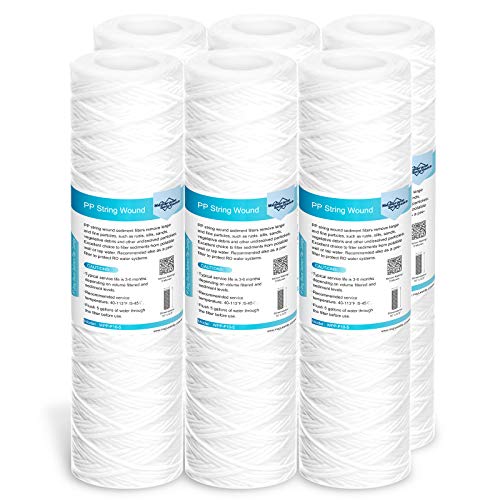
The Membrane Solutions 5-micron, 10″x2.5″ string-wound sediment cartridges are designed as universal replacements for many 10-inch housings used in well-water filtration. Constructed from food-grade polypropylene, these cartridges are lead- and BPA-free, reducing the risk of leaching while capturing dirt, sand, silt, rust, and scale. Their four-times dirt-holding capacity and higher flow potential make them a practical choice as a prefilter stage or as part of a multi-stage system in well-water applications.
These cartridge-style filters are widely compatible, offering straightforward installation and straightforward maintenance. The 5-micron rating provides solid pre-filtration, helping to extend the life of subsequent carbon blocks or specialty filters. For well owners seeking a cost-effective, replacement option for sediment control, this Membrane Solutions line delivers reliable performance and broad compatibility across many standard housings.
Buying Guide
- Identify your well water issues: common concerns include iron and manganese staining, sediment load, taste and odor problems from chlorine or hydrogen sulfide, and potential heavy metals. Prioritize filtration stages that address your most pressing contaminants.
- Assess flow requirements: determine how many gallons per minute (GPM) you need based on household size and peak usage. Higher flow needs often require filters with larger capacity or staged designs that minimize pressure drop.
- Choose between whole-house vs. staged filtration: whole-house systems protect every faucet and appliance, while staged or point-of-entry solutions can be tailored with sediment prefilters or iron/odor treatment as needed.
- Consider filtration stages and media types: multi-stage systems (polypropylene sediment, carbon block, iron/manganese media) provide broad contaminant reduction. Carbon blocks improve taste and odor, while catalytic media target iron and manganese more efficiently than greensand in some cases.
- Check filter lifespans and replacement costs: some cartridges last 6 months, while other systems offer long-life filters up to 100,000 gallons. Balance upfront cost with ongoing cartridge expenses for long-term value.
- Look for certifications and claims: NSF/ANSI certifications help verify contaminant reduction capabilities. Compare independent testing results to ensure performance aligns with your well conditions.
- Examine installation ease and compatibility: ensure 1″ or 3/4″ connections fit your plumbing. DIY-friendly kits often include mounting brackets and handy valves for easier maintenance.
- Plan maintenance and indicators: choose systems with visible gauges or simple indicators to track when replacements are due. Consider backwash features for sediment control to reduce frequent cartridge changes.
- Factor environmental and water hardness considerations: well water can carry minerals that impact filter life. In areas with hard water, prefilters and iron filters may be particularly beneficial to protect downstream appliances.
- Balance upfront cost with long-term reliability: while premium multi-stage systems offer broader protection, a well-muited combination of a sediment prefilter, iron/manganese treatment, and a carbon stage often delivers the best overall value for many households.